

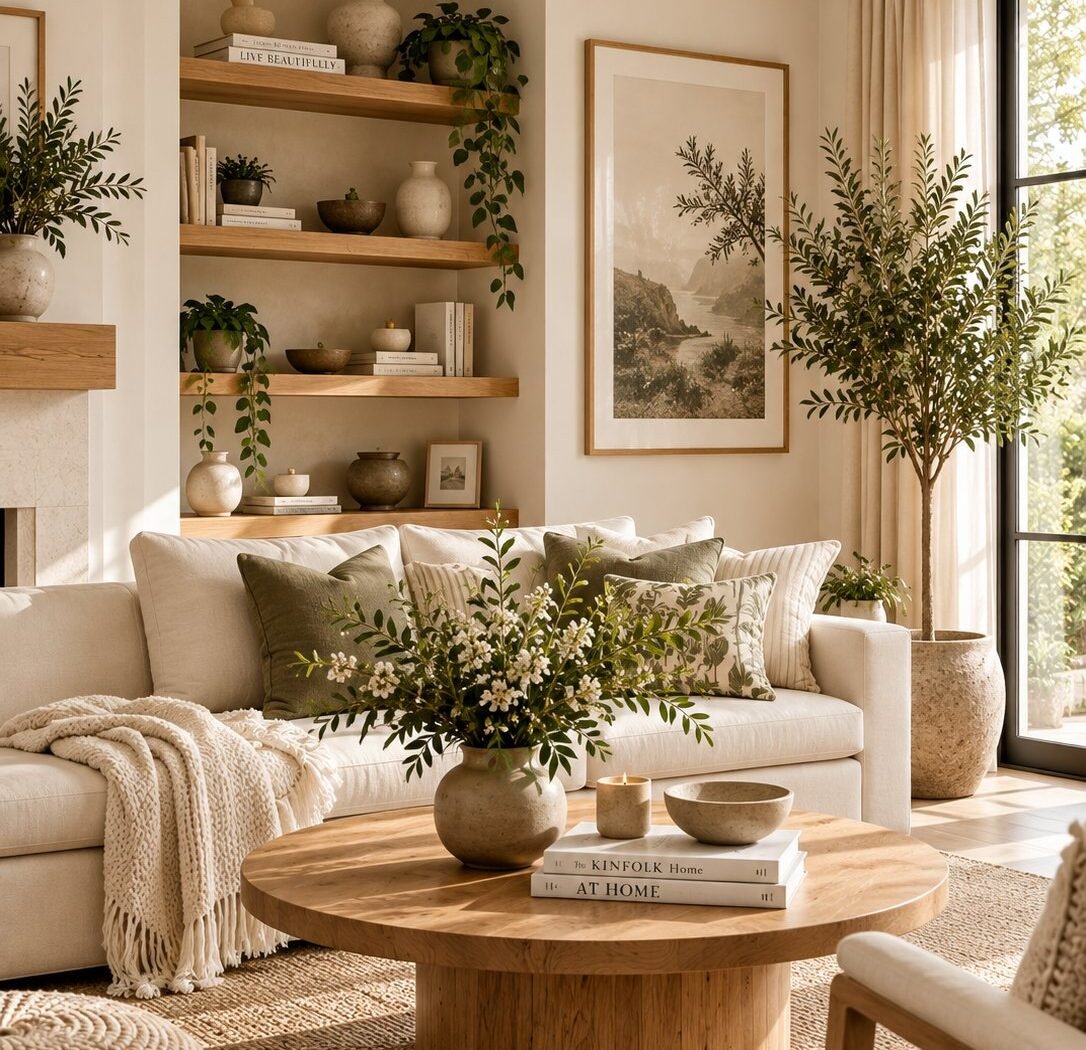
Small-room advice usually amounts to “buy smaller furniture”, which is both obvious and often wrong. A few well-scaled pieces will nearly always beat several apologetic ones. What follows works with the constraint rather than pretending it is not there.
Free up the floor
Legs matter. A sofa raised on visible legs shows the floor continuing underneath it, and a floor you can see reads as a floor you have. Wall-mounted shelving and a hung console do the same thing.
Protect the sightline
Stand in the doorway. Whatever your eye hits first sets the room's apparent size. Keep that line clear to the far wall or the window, and put the bulk of the storage behind you.
Go tall, not wide
Full-height shelving costs the same footprint as a low unit and holds three times as much. It also draws the eye up, which is the whole trick.
One large mirror, placed deliberately
Opposite or adjacent to a window, so it returns daylight rather than reflecting a wall. A large mirror in the wrong place is just a large object.
Keep the palette continuous
Walls, woodwork and larger pieces in the same tonal family remove the visual joins that chop a small room into sections. Save contrast for cushions and art.
Choose furniture that does two jobs
A storage ottoman is a footstool, a seat and a box. A nesting pair is one table until you need two. This is the one place where compromise genuinely pays.
And accept the trade-offs
A small room cannot seat eight comfortably and also feel open. Decide which of those you actually want, and let the room be very good at that.